Certified vs. Non-Certified EHR: What Should a Medical Practice Choose
- Written by Kiran Agate, VP
- When choosing an electronic health record (EHR), medical practices may encounter both ONC-certified EHRs and non-certified EHR systems. Non-certified products may offer lower pricing and simpler functionality, while certified EHR technology provides standardized capabilities that can be particularly important for interoperability, data exchange, and data portability. Neither option is automatically right for every practice. Understanding what EHR certification means—and what it does not mean—can help practices make a better long-term technology decision.
Certified vs. Non-Certified EHR: What Should a Medical Practice Choose
- Written by Kiran Agate, VP
- When choosing an electronic health record (EHR), medical practices may encounter both ONC-certified EHRs and non-certified EHR systems. Non-certified products may offer lower pricing and simpler functionality, while certified EHR technology provides standardized capabilities that can be particularly important for interoperability, data exchange, and data portability. Neither option is automatically right for every practice. Understanding what EHR certification means—and what it does not mean—can help practices make a better long-term technology decision.
Certified vs. Non-Certified EHR: What Should a Medical Practice Choose?
What Is a Certified EHR?
The ONC Health IT Certification Program establishes certification criteria for health information technology. Certified health IT must demonstrate conformance with the applicable certification criteria, which cover specific technological capabilities, functionality, interoperability, and security requirements.
Certification should not be confused with a general rating of whether one EHR is “better” than another. Rather, it provides assurance that a product has demonstrated conformance with the specific criteria for which it is certified.
For medical practices evaluating EHR software, certification can therefore be an important consideration alongside usability, specialty-specific workflows, implementation support, pricing, and overall functionality.
Why Do Some Practices Choose a Non-Certified EHR?
1. Lower Cost Can Be Attractive
One of the potential advantages of a non-certified EHR is lower pricing.
Maintaining certified health IT can require ongoing development, testing, regulatory monitoring, documentation, and compliance activities. Some smaller EHR vendors that do not pursue certification may be able to offer their products at lower prices.
For a small or highly specialized practice that primarily needs electronic charting, scheduling, billing, document management, or other basic functionality, price may be an important consideration.
However, practices should compare more than the monthly subscription price. Costs associated with integrations, interfaces, data exports, migration, interfaces with outside organizations, and eventually changing EHR systems can affect the total cost of ownership.
2. Simpler Requirements May Not Need Every Certified Capability
Not every medical practice has the same interoperability requirements.
A practice that operates relatively independently and has limited requirements for exchanging clinical information with hospitals, laboratories, other providers, health information exchanges, applications, or patients may not need every capability associated with certified health IT.
In these circumstances, a non-certified EHR could potentially provide the functionality the practice needs at a lower cost.
The key question is whether those requirements are likely to remain simple throughout the growth of medical practice.
What Are the Advantages of Choosing a Certified EHR?
1. Standardized Interoperability
One of the most important advantages of certified EHR technology is its support for standardized healthcare data exchange.
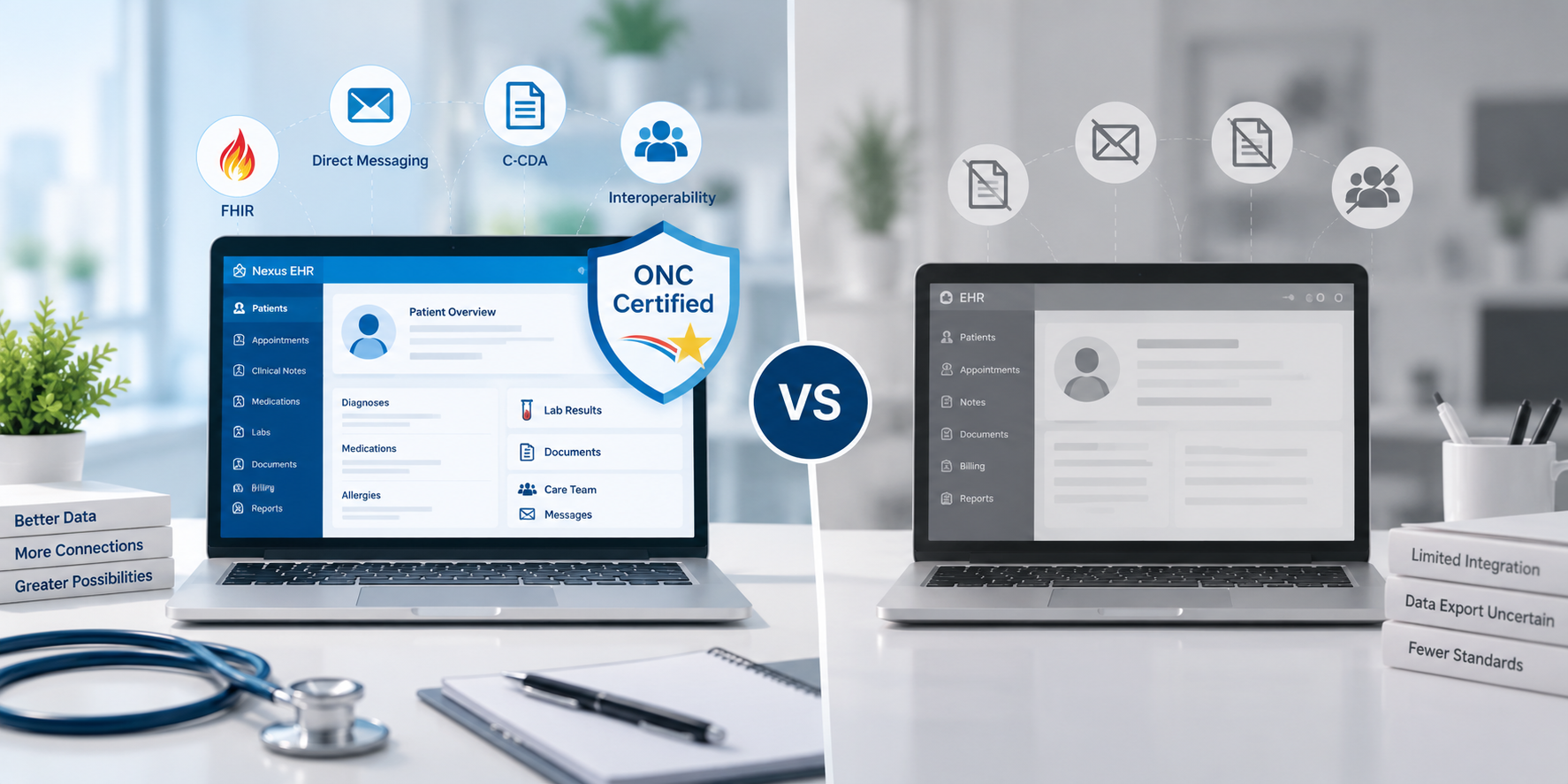
Depending on the certification criteria applicable to the product, certified health IT can support standards and technologies such as:
- FHIR APIs for standardized access to healthcare information
- C-CDA for exchanging structured clinical documents
- Direct messaging for secure clinical information exchange
- USCDI and other standards that help establish common data elements and terminology
For example, ONC’s standardized API certification criterion incorporates HL7 FHIR standards, and certified API developers are subject to requirements designed to allow electronic health information to be accessed, exchanged, and used through APIs.
This standardization becomes increasingly valuable as practices need their EHR to communicate with other parts of the healthcare ecosystem.
2. Better Foundation for Connecting with Other Healthcare Systems
Interoperability is more than simply having an API.
If two systems collect similar clinical information in completely different formats, exchanging that information and interpreting it consistently can become difficult.
Certification establishes requirements around particular standards and data structures. This can provide a more predictable foundation for exchanging information among EHRs, hospitals, healthcare applications, and other systems.
This does not mean that every certified EHR will automatically integrate with every healthcare organization. Interfaces, configuration, participation agreements, and implementation work may still be required.
Certification nevertheless provides a stronger standardized foundation upon which interoperability can be built.
3. Data Portability and EHI Export
Practices should also consider a question that is sometimes overlooked when purchasing an EHR:
What happens to our data if we eventually leave the system?
ONC certification includes an Electronic Health Information (EHI) export criterion for certified Health IT Modules that store or cause EHI to be stored.
The criterion includes capabilities for both single-patient and patient-population EHI exports. The exported information must be electronic and provided in a computable format, and documentation describing the export format must be publicly accessible.
Importantly, ONC does not mandate one universal export format for this requirement. Depending on the system, an export might use formats or standards such as C-CDA, CSV, FHIR, or another documented computable format.
For a medical practice, this creates an important level of predictability around the ability to retrieve information from certified technology.
A non-certified EHR is not subject to ONC certification requirements for EHI export. Therefore, practices considering a non-certified system should examine the vendor’s contract carefully and ask:
Can we export all of our data? In what format? How much will an export cost? Can another EHR reasonably import or process that information?
These questions can be as important as the cost of initially implementing the EHR.
Certified vs. Non-Certified EHR: Quick Comparison
| Consideration | ONC-Certified HER | Non-Certified EHR |
| Pricing | May involve higher costs depending on product and services | May offer lower-cost options |
| FHIR/API capabilities | Standardized capabilities when applicable certification criteria are included | Vendor-dependent |
| C-CDA support | Supported where required by applicable certification criteria | Vendor-dependent |
| Standardized clinical data | Certification establishes applicable standards | Vendor-dependent |
| EHI export | Applicable certified products must meet ONC EHI export requirements | Determined by vendor/product |
| Data portability | More standardized and defined requirements | Should be verified before purchase |
| Regulatory programs requiring CEHRT | Can satisfy applicable requirements when the necessary certification criteria are met | Generally cannot substitute where CEHRT is specifically required |
| Basic practice workflows | Usually available but product-dependent | May be sufficient for practices with simple requirements |
Questions to Ask Before Selecting Either Type of EHR
Instead of asking only, “Is this EHR certified?”, practices should consider their complete technology requirements.
Ask prospective EHR vendors about interoperability, FHIR APIs, C-CDA support, Direct messaging, laboratory connectivity, patient access, data export formats, migration assistance, and costs associated with retrieving data.
Practices should also verify whether participation in any current or anticipated government, payer, quality-reporting, or interoperability program requires the use of Certified EHR Technology (CEHRT).
Finally, ask the vendor to explain exactly which ONC certification criteria apply to its product rather than assuming that the word “certified” means every possible capability is included.
Conclusion: Which Type of EHR Should You Choose?
There is no single answer that applies to every medical practice.
A non-certified EHR may be worth considering when a practice has relatively simple clinical requirements, limited interoperability needs, no program requirement for certified technology, and places a high priority on minimizing software costs.
An ONC-certified EHRs like Nexus EHR may deserve greater consideration when a practice expects to exchange clinical information with other healthcare organizations, use standardized APIs, participate in programs requiring certified technology, or wants greater assurance around standardized data exchange and future data portability.
The decision should therefore extend beyond the initial monthly price.
An EHR is often used for many years, during which a practice’s requirements can change significantly. Evaluating interoperability, data ownership and portability, integration capabilities, regulatory requirements, workflow, support, and total long-term cost can help a practice choose technology that meets both its immediate and future needs.
Frequently Asked Questions
What is the main difference between a certified and non-certified EHR?
An ONC-certified health IT product has demonstrated conformance with specific certification criteria established under the ONC Health IT Certification Program. A non-certified product has not demonstrated compliance through that certification process.
Does an ONC-certified EHR support FHIR?
FHIR support depends on the criteria to which the product is certified. Health IT certified to ONC’s standardized API criterion uses specified FHIR-based standards. Practices should verify the individual product’s certification and capabilities rather than assuming every certified module provides identical functionality.
Can I get my data out of a certified EHR?
Certified Health IT Modules that store or cause EHI to be stored must meet ONC’s EHI export certification criterion. This includes electronic, computable exports for individual patients and patient populations. The exact export format can vary by product.
Nexus EHR is certified for EHI export certification criteria and has standard data export available at no cost unless there is specific customized requirements are given for data export by the customer.
Does EHI export have to be in C-CDA format?
No. ONC does not require C-CDA to be the single export format for the EHI export criterion. C-CDA may be used, but a product can use another electronic and computable format with publicly available documentation.
Nexus EHR offers clinical data in C-CDA format as part of EHI export while other data like document index is provided in CSV format.