How eRx module Strengthens Medication Management in Nexus EHR
- Written by Kiran Agate, VP
How eRx module Strengthens Medication Management in Nexus EHR
- Written by Kiran Agate, VP
Electronic prescribing is no longer simply a convenient replacement for handwritten prescriptions. In a modern ambulatory practice, the prescribing workflow should help clinicians select an appropriate medication, identify safety concerns, check insurance coverage, manage prior authorization requirements, transmit prescriptions securely, and review controlled-substance history when required.
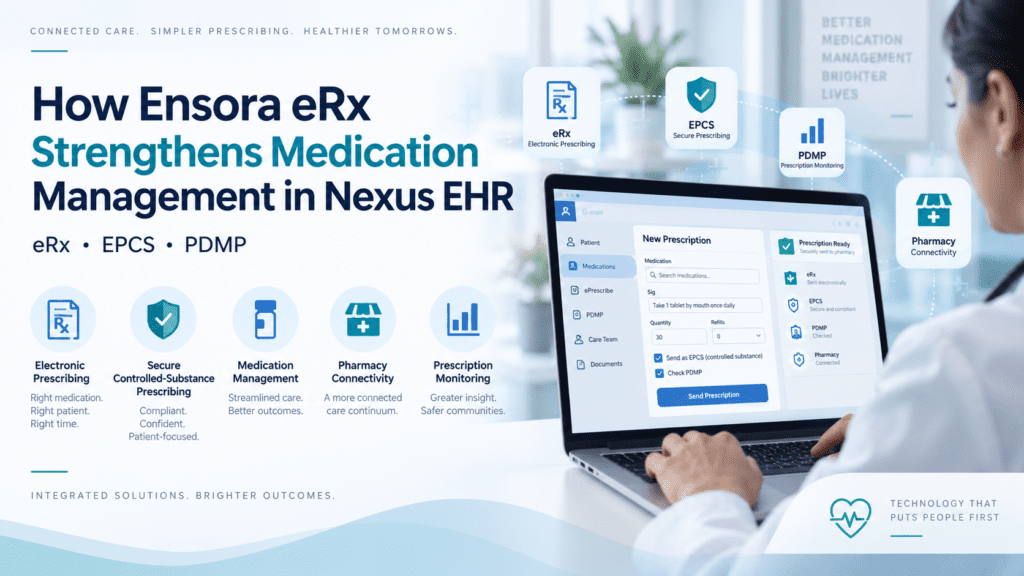
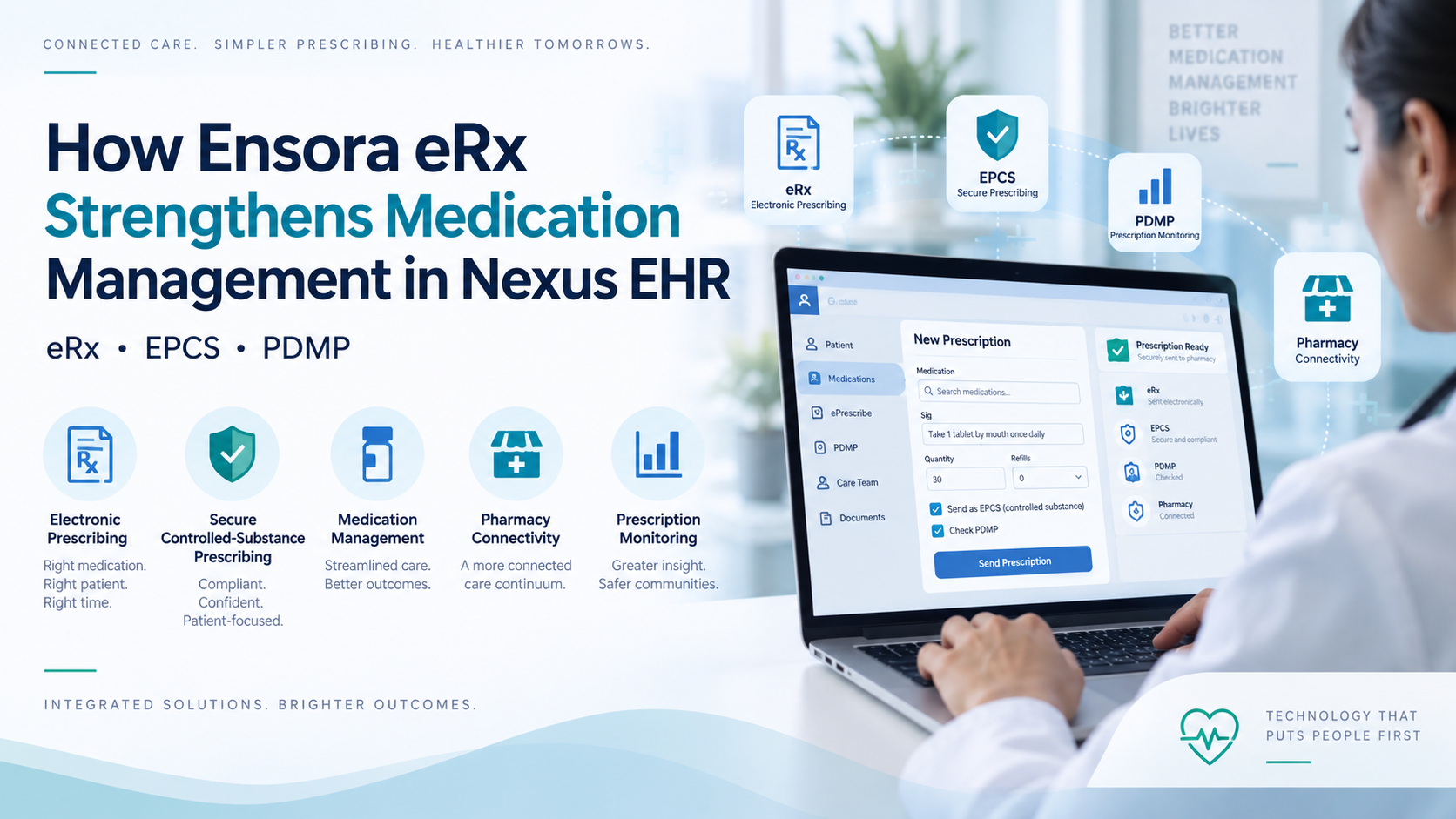
Nexus EHR integrates with Ensora eRx—formerly known as NewCrop—to provide electronic prescribing, Electronic Prescribing of Controlled Substances (EPCS), and Prescription Drug Monitoring Program (PDMP) capabilities within its clinical platform.
The value of these capabilities becomes clearer when the three components are considered together:
- Electronic prescribing, or eRx, allows a provider to send an accurate and understandable prescription electronically from the point of care to a pharmacy.
- EPCS extends the electronic workflow to Schedule II–V controlled substances using stronger identity, authentication, security, and auditing controls.
- PDMP information provides controlled-substance prescription history that may help clinicians identify duplicate therapy, uncoordinated prescribing, risky medication combinations, or potential overdose risk.
CMS describes e-prescribing as an important element in improving the quality of patient care because it enables accurate and understandable prescriptions to be transmitted directly to pharmacies. Together, the capabilities provided through eRx module can make prescribing safer for patients and more manageable for providers and clinic staff.
What Are the Key Features of eRx module?
Electronic prescribing and pharmacy routing
Our integrated eRx module enables prescriptions to be prepared and electronically transmitted to participating pharmacies. Electronic routing reduces dependence on paper prescriptions, manual faxing, and telephone calls.
It also creates a more standardized and legible prescription record. Pharmacies are less likely to need clarification because they cannot read the prescriber’s handwriting or because essential prescription information is missing.
Because prescribing is connected to the patient’s electronic chart in Nexus EHR, clinicians can work from a more complete clinical context instead of switching to a separate prescribing application. This supports the broader Nexus EHR objective of giving providers an integrated workspace for clinical documentation, ordering, prescribing, and reviewing patient information.
Electronic prescribing of controlled substances
The eRx module supports EPCS in all 50 states and allows qualified and registered prescribers to electronically transmit controlled-substance prescriptions. Its EPCS workflow includes prescriber identity verification and two-factor authentication using ID.me. This is important from both an operational and compliance perspective. CMS states that EPCS can improve the timely and accurate transmission of controlled-substance prescriptions. It can also reduce prescriber burden by helping detect fraud or irregularities, avoiding data-entry errors, improving workflow efficiency, and reducing pharmacy calls for clarification.
Providers must continue to follow federal requirements, state laws, DEA regulations, and their organization’s prescribing policies. However, our integrated eRx gives practices the technology needed to incorporate controlled-substance prescribing into a secure electronic workflow.
Integrated PDMP access
A PDMP is an electronic database that tracks controlled-substance prescriptions. The CDC notes that PDMP information can help clinicians identify patients who may be at risk of overdose. It can also provide valuable medication history when information is unavailable or when a patient transitions to a new clinician.
Providers can access automated PDMP information as part of its EPCS capabilities. Bringing this information closer to the prescribing workflow can reduce the need to leave the EHR, sign into a separate state portal, locate the patient, review the record, and then return to the chart.
More convenient access can support consistent PDMP review before controlled medications are prescribed, subject to state-specific access rules and reporting requirements.
Drug, allergy, disease, dose, and duplicate-therapy checks
One of the strongest advantages of electronic prescribing is the ability to evaluate a proposed prescription against information already documented in the patient’s chart.
The eRx module provides clinical review capabilities for:
- Drug-drug interactions
- Drug-allergy interactions
- Drug-disease interactions
- Duplicate therapy
- Potential dosing concerns
The module also offers pharmacogenomic review capabilities for organizations using genomics-based decision support.
These checks do not replace clinical judgment. Instead, they give the prescriber another opportunity to identify a potential problem before the prescription reaches the pharmacy or the patient begins treatment.
Point-of-care drug reference information
Our integrated eRx module provides access to Lexicomp drug information. Available resources include drug monographs, calculators, medication identifiers, interaction information, overdose assessments, and patient education materials.
Point-of-care reference access can be especially useful when a provider is:
- Prescribing an unfamiliar medication
- Evaluating an appropriate dose
- Reviewing a possible interaction
- Considering age-related or clinical risk factors
- Counselling a patient about administration or adverse effects
Rather than searching through a separate reference system, providers can obtain relevant information while reviewing the patient’s chart and preparing the prescription.
Electronic prior authorization
Prior authorization can delay treatment and create repeated work for providers, staff members, pharmacies, and patients. Ensora eRx can identify prior authorization requirements during prescribing and supports electronic prior authorization, or ePA, submission.
Earlier identification gives the care team an opportunity to act before the patient encounters a rejection at the pharmacy. When clinically appropriate, the provider may select a covered alternative. Otherwise, staff can begin submitting the authorization electronically.
Although the insurer still controls the final determination, starting the process earlier can reduce unnecessary telephone calls, paper forms, faxes, and follow-up work.
Formulary and real-time benefit information
The eRx module provides managed-care formulary information and real-time benefit tools that can display patient-specific coverage, medication cost information, and possible alternatives at the point of care.
The formulary functionality obtains information through Surescripts, participating pharmacy benefit managers, and other data sources. Real-time benefit tools provide access to pricing for a proposed drug and potential alternatives while the provider is prescribing.
This feature addresses a common breakdown in medication access: the patient arrives at the pharmacy and discovers that the medication is not covered or costs more than expected.
Seeing coverage and cost information during the encounter allows the provider and patient to discuss alternatives before the prescription is transmitted.
Customizable prescribing tools
eRx module includes favorites, integrated recommendations, and configurable tools designed to adapt to a provider’s prescribing patterns. Frequently used medications and common prescribing instructions can be easier to retrieve, reducing repetitive data entry.
These capabilities can be particularly useful for specialists and primary care providers who repeatedly treat common conditions. Providers can complete routine prescriptions more efficiently while retaining access to patient-specific clinical alerts and coverage information.
Features That Are Useful for Providers and Clinic Staff
For providers, the primary advantage is having more information available at the moment a medication is selected.
Interaction checks, allergy alerts, dosing review, drug references, formulary information, real-time benefits, and PDMP history each contribute a different part of the clinical picture. Instead of treating prescribing as a final administrative step, Ensora eRx makes it part of the clinical decision-making process.
EPCS also allows controlled-substance prescribing to remain within an electronic workflow. Providers do not have to interrupt the visit to locate a prescription pad, print a prescription, or create a separate manual record. Secure authentication and electronic transmission help maintain accountability while improving convenience.
Clinic staff can benefit from:
- Fewer avoidable pharmacy clarification calls
- More complete and legible prescription instructions
- Earlier awareness of coverage limitations
- Electronic processing of prior authorization requests
- Better visibility into medication and refill history
- Less dependence on paper, fax, and telephone-based workflows
Electronic prior authorization can be particularly valuable for staff. When the system identifies that a medication requires authorization, the team can begin working on it before the patient has made repeated calls to the pharmacy and the practice.
A connected medication workflow also supports continuity in group practices. Providers, nurses, medical assistants, and authorized staff can review medication information in the context of the Nexus EHR chart when processing refills, reconciling medications, coordinating care, or following up with patients.
Features That Can Help Patients
Patients may experience the benefits of our eRx module even though they do not directly operate the prescribing module.
First, electronic transmission can shorten the time between the visit and the pharmacy receiving the prescription. It also reduces problems caused by illegible handwriting, incomplete information, or misplaced paper prescriptions.
Second, clinical alerts may help prevent avoidable medication-related harm. The system can warn the prescriber about a documented allergy, potential interaction, duplicate therapy, disease-related concern, or questionable dose before the medication is dispensed.
Third, formulary and real-time benefit information can make medication cost part of the treatment discussion. When coverage details and alternatives are available during the visit, the provider may be able to choose an option that is both clinically appropriate and more affordable. This may reduce prescription abandonment and the frustration of discovering an unexpected price at the pharmacy.
Fourth, electronic prior authorization can reduce treatment delays. Patients may still need to wait for an insurer’s decision, but identifying the requirement earlier gives the practice a better opportunity to submit the necessary information promptly or discuss an appropriate alternative.
Finally, patient education resources can improve understanding of how and why a medication should be taken. Multilingual drug information leaflets and disease education resources that can help practices provide clearer instructions to a diverse patient population.
Closing Summary
The Ensora eRx integration strengthens Nexus EHR by connecting routine e-prescribing, controlled-substance prescribing, PDMP information, clinical safety checks, drug references, coverage intelligence, and prior authorization workflows to the patient’s electronic record.
For providers, the result is better information at the point of prescribing and a more consistent workflow for controlled and non-controlled medications. For clinic staff, it can mean fewer manual steps, fewer clarification calls, and earlier action on prior authorization and coverage issues. For patients, it can support safer medication choices, faster pharmacy communication, greater cost transparency, and fewer preventable delays.
No electronic prescribing system replaces a provider’s clinical judgment or a practice’s responsibility to follow federal and state requirements. However, when implemented as part of an integrated clinical workflow, The eRx module helps Nexus EHR users make medication management more informed, secure, efficient, and patient- centered.