How Much Time Can an AI Medical Scribe Save Per Day
- Written by Pooja Tripathi, CEO
- What if you got three hours back, every single day? Not three hours of idle time. Three hours of your time. The kind that currently disappears into chart notes, template navigation, code selection, and post-visit documentation that has nothing to do with why you became a physician. That is the promise of AI medical scribe software, and in 2026, it is no longer a promise. It is a documented, peer-reviewed clinical outcome. This article breaks down exactly how much time an AI scribe for physicians saves, where those savings come from, and what they mean for your practice, your patients, and your life outside the clinic.
How Much Time Can an AI Medical Scribe Save Per Day
- Written by Pooja Tripathi, CEO
- What if you got three hours back, every single day? Not three hours of idle time. Three hours of your time. The kind that currently disappears into chart notes, template navigation, code selection, and post-visit documentation that has nothing to do with why you became a physician. That is the promise of AI medical scribe software, and in 2026, it is no longer a promise. It is a documented, peer-reviewed clinical outcome. This article breaks down exactly how much time an AI scribe for physicians saves, where those savings come from, and what they mean for your practice, your patients, and your life outside the clinic.
How Much Time Can an AI Medical Scribe Save Per Day? (The Numbers Every Physician Should See)
The Documentation Time Drain: Where Your Hours Actually Go
Before quantifying what AI saves, you need to see clearly what manual documentation is taking.
Studies across US healthcare systems consistently show the same pattern:
- Physicians spend 2–3 hours per day on clinical documentation, separate from patient care hours, with national EHR metadata showing 2.3 hours per 8-hour session on notes alone. (Source: National Comparison of Ambulatory Physician EHR Use – JAMA/NCBI)
- For every 1 hour of face time with a patient, clinicians average nearly 2 hours of EHR work. (Source: University of Chicago / arXiv peer-reviewed study)
- Family medicine physicians spend up to 84 minutes per day on documentation tasks alone, not clinical reasoning, just writing and formatting notes. (Source: Tethered to the EHR – Primary Care Physician Workload Study, PMC/NCBI)
- Physicians average 1.4 hours of EHR use after clinic hours every day, evenings and weekends consumed by charts that did not get finished during the clinical day. (Source: Tethered to the EHR – PMC/NCBI)
Add it up across a five-day work week and a typical physician is spending the equivalent of a full additional workday every week on documentation. That is not inefficient, that is a structural design failure, and ambient clinical documentation AI is the fix.
So How Much Time Does an AI Medical Scribe Actually Save?
Let’s be specific, because the answer depends on how your day is structured.
Per Encounter: 15–25 Minutes Saved
Manual documentation for a standard office visit, including note construction, template navigation, and code entry, takes the average physician 15 to 25 minutes per encounter when completed post-visit.
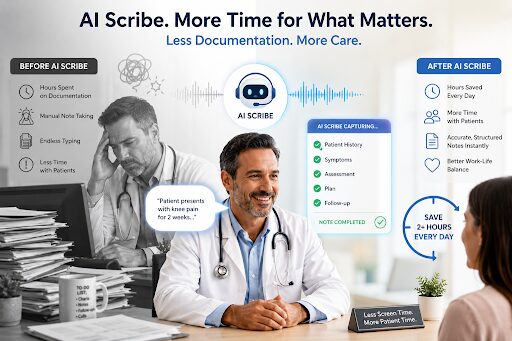
With automated clinical note software like Nexus Intelligence Scribe, that same encounter produces a structured, review-ready chart note in seconds. The physician spends 2–3 minutes reviewing and approving the AI-generated draft. That is a saving of 12–22 minutes per encounter.
(Estimated based on commonly reported post-visit documentation times. Actual savings may vary by specialty, patient complexity, and workflow. Nexus Clinical makes no guarantee of specific time savings)
Per Day: Up to 3 Hours Returned
For a physician the math compounds fast for the number of patients they are seeing in a day.
That is not marginal. For a clinic, 2+ hours saving a day is a complete transformation of how the workday feels and ends.
Per Year: Over 700 Hours of Clinical Capacity
Three hours per day, five days a week, across a standard clinical calendar, that is more than 700 hours per year per physician.
Seven hundred hours is:
- Equivalent to 18 full work weeks of time
- Enough to see hundreds of additional patients, without extending hours
- Enough to completely eliminate after-hours charting for most practices
- Enough to meaningfully reduce physician burnout before it becomes attrition
A multi-center October 2025 study published in JAMA Network Open, covering 263 physicians across six US health systems, found that ambient AI scribes reduced burnout from 51.9% to 38.8% in just 30 days, representing a 74% reduction in the odds of experiencing burnout. (Source: JAMA Network Open / Yale School of Medicine – PMC Full Study)
A second study across Mass General Brigham and Emory Healthcare confirmed a 21.2% absolute burnout reduction at 84 days of use. (Source: Mass General Brigham Press Release – August 2025) The mechanism is simple: exhaustion accumulates from cognitive overload. Remove the overload, reduce the exhaustion.
Where the Time Savings Come From: Breaking Down the AI Scribe Workflow
The time reduction is not magic, it is workflow redesign. Here is exactly where AI medical scribe software eliminates documentation steps that manual charting requires:
Eliminated: Post-Visit Note Construction
Manual: Physician recalls the encounter from memory and reconstructs it in structured format. AI Scribe: The note is built during the encounter from the live conversation. Nothing to reconstruct.
Eliminated: Template Navigation and Field Population
Manual: Physician clicks through HPI, ROS, Physical Exam, Assessment, and Plan fields individually. AI Scribe: All sections are auto-populated from the encounter content, pre-structured, pre-formatted, ready to review.
Eliminated: Manual ICD-10 and CPT Code Lookup
Manual: Physician or biller searches for appropriate codes based on documented findings. AI Scribes like Nexus Intelligence Scribe suggests ICD-10 and CPT codes automatically based on the actual clinical conversation, reducing lookup time and under coding simultaneously. For specialty practices managing complex coding profiles in cardiology, neurology, or orthopedics, this step alone is a significant time and revenue recovery.
Eliminated: After-Hours Charting
Manual: Notes unfinished during clinic carry over into evenings and weekends. AI Scribe: Notes are completed, and physician-approved, before the patient leaves or immediately after. Zero backlog. Zero pajama time.
Want to see this workflow live inside a real EHR? Watch Nexus Intelligence Scribe generate a chart note or request a live demo from our website
Beyond Time: What You Actually Do With 3 Hours Back
Time savings are quantifiable. What physicians do with that time is the part that matters.
The clinicians who adopt AI scribe for physicians consistently report the same outcomes:
- More present patient interactions. When documentation happens automatically, the physician makes eye contact instead of staring at a screen. Patients notice. Satisfaction scores improve.
- Increased patient capacity. Some practices use recovered time to see 3–5 additional patients per day, generating meaningful revenue without extending hours.
- Faster patient engagement follow-up. With documentation done, same-day follow-up communications, referrals, and care coordination tasks get completed during clinic hours instead of piling up.
- A career that is sustainable. This is the one that does not show up in ROI spreadsheets but drives every AI scribe adoption decision: physicians who stop dreading documentation start staying in medicine longer.
The Nexus Intelligence Scribe Advantage
Most AI SOAP note generators on the market are standalone tools, you record in one app, receive a note, copy it, paste it into your EHR. Every one of those steps costs time. The switching, the copying, the reconciliation, it quietly erodes the savings the tool was supposed to deliver.
Nexus Intelligence Scribe is built natively inside Nexus EHR. The recording happens inside the chart. The note is generated inside the chart. The physician reviews inside the chart. There is no second application, no copy-paste, no tab-switching. For practices already on Nexus EHR, the time savings begin from the very first encounter, with zero onboarding friction.
The result is not just faster documentation. It is a fundamentally lighter clinical day, the kind that ends at the clinic, not at the kitchen table at 10 PM.
Three hours a day is not a small thing. Reclaim it.
See Nexus Intelligence Scribe in Action – Request Your Live Demo Today
Nexus Intelligence Scribe is HIPAA-compliant and built inside Nexus EHR.