Reappr(AI)se Your EHR
- Written by Kiran Agate, VP
- The healthcare industry is undergoing a profound transformation with introduction of Artificial Intelligence (AI). What began as experimental tools for predictive analytics has now become deeply embedded in modern Electronic Health Record (EHR) systems. Gone are the days of EHR being mere digital filing cabinet with incremental automation related enhancements and interoperability features.
Reappr(AI)se Your EHR
- Written by Kiran Agate, VP
- The healthcare industry is undergoing a profound transformation with introduction of Artificial Intelligence (AI). What began as experimental tools for predictive analytics has now become deeply embedded in modern Electronic Health Record (EHR) systems. Gone are the days of EHR being mere digital filing cabinet with incremental automation related enhancements and interoperability features.

How Artificial Intelligence is Transforming Clinical Workflows
Introduction
AI adoption in healthcare has accelerated automation and interoperability significantly in recent years. According to a study by Stanford Medicine, nearly 75% of healthcare organizations are actively exploring or implementing AI solutions in clinical workflows. Similarly, a 2023 report by McKinsey highlights that AI could generate up to $150 billion annually in savings for the U.S. healthcare system by improving efficiency and outcomes.
For deeper insights:
We had discussed a while back about Physician burnout and need to reduce burnout. As providers face increasing administrative burden, physician burnout, and rising patient expectations, AI-enabled EHRs are emerging as a critical solution to streamline workflows and enhance care delivery.
How EHRs are being reimagined with AI?
Modern EHR platforms are integrating AI across multiple layers of clinical and operational workflows. These enhancements are not just incremental—they fundamentally redefine how providers interact with patient data.
1. Clinical Documentation Automation
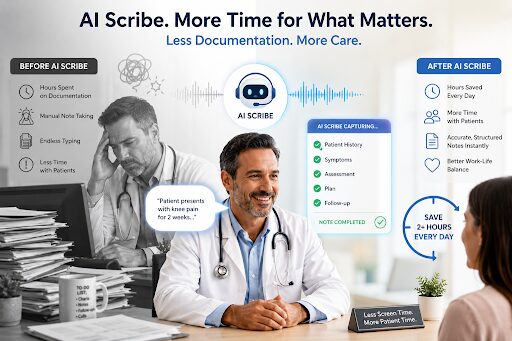
AI-powered voice recognition and natural language processing (NLP) tools can transcribe and structure physician-patient conversations in real time.
This AI module typically:
- Convert speech to structured SOAP notes
- Auto-populates diagnosis and procedure codes
- Reduces documentation time significantly to save 2+ hours everyday
This is often referred to as AI scribe or Ambient Listener, helping providers focus on patients rather than screens.
2. Clinical Decision Support Systems (CDSS)
AI enhances traditional decision support by analyzing large datasets to provide intelligent recommendations.
- Suggests diagnoses based on symptoms and history
- Flags potential drug interactions
- Identifies care gaps and preventive measures
These systems go beyond static alerts and become adaptive, learning from patient populations and outcomes.
3. Predictive Analytics
AI models can analyze historical and real-time patient data to predict future risks.
- Readmission risk prediction
- Chronic disease progression tracking
- Early detection of sepsis or deterioration
For example, studies published by the National Institutes of Health show AI can detect sepsis hours before clinical symptoms appear, improving survival rates.
NIH study reference
4. Revenue Cycle Optimization
AI is also transforming the financial side of healthcare.
- Automated coding (CPT/ICD)
- Claim scrubbing and denial prediction
- Prior authorization assistance
By reducing human error and administrative overhead, AI significantly improves reimbursement cycles.
5. Patient Engagement and Virtual Assistants
AI-powered chatbots and virtual assistants are now integrated into patient portals.
- Appointment scheduling
- Medication reminders
- Symptom triage
These tools provide 24/7 patient support, reducing call center burden and improving patient satisfaction.
6. Workflow Automation
AI helps automate repetitive administrative tasks.
- Task routing and prioritization
- Smart inbox filtering
- Document classification and indexing
This creates a more streamlined and efficient clinical environment.
7. Imaging and Diagnostics Integration
EHRs are increasingly integrating AI diagnostic tools for radiology, pathology, cardiology and wound care.
- Automated image interpretation
- Highlighting abnormalities
- Decision support for radiologists
This enhances diagnostic accuracy and speeds up turnaround times.
What Are the Advantages of AI in EHR?
The integration of AI into EHR systems offers significant benefits across clinical, operational, and financial domains.
1. Reduced Physician Burnout
Administrative tasks account for a large portion of a physician’s workload. AI reduces documentation burden, allowing providers to spend more time with patients.
- Less typing and manual entry
- Faster chart completion
- Improved work-life balance
2. Improved Clinical Outcomes
AI-driven insights enable earlier intervention and more accurate diagnoses.
- Better chronic disease management
- Reduced hospital readmissions
- Enhanced preventive care
3. Increased Efficiency and Productivity
Automation of routine tasks leads to faster workflows.
- Reduced time per patient encounter
- Streamlined care coordination
- Faster decision-making
4. Enhanced Data Utilization
EHRs contain vast amounts of data, but traditional systems struggle to extract meaningful insights. AI unlocks this potential.
- Pattern recognition across populations
- Personalized treatment plans
- Real-time analytics
5. Financial Performance Improvement
AI helps optimize revenue cycle management.
- Fewer claim denials
- Accurate coding
- Faster reimbursements
6. Better Patient Experience
AI-powered engagement tools create a more responsive and personalized experience.
- Faster communication
- Improved access to care
- Higher patient satisfaction
Common Pitfalls of AI in EHR and How to Address Them?
While AI offers immense benefits, its implementation is not without challenges. Understanding these pitfalls is critical for successful adoption.
1. Data Quality Issues
AI models are only as good as the data they are trained on.
Problem:
- Incomplete or inconsistent patient records
- Bias in datasets
Solution:
- Implement strong data governance
- Use standardized formats (FHIR, HL7)
- Continuous data validation
2. Workflow Disruption
Poorly implemented AI can disrupt clinical workflows instead of improving them.
Problem:
- Alert fatigue
- Complex interfaces
Solution:
- Design AI tools around clinician workflows
- Prioritize usability and minimal disruption
- Provide customization options
3. Trust and Adoption Barriers
Clinicians may be skeptical of AI recommendations.
Problem:
- Lack of transparency in AI decisions
- Fear of over-reliance
Solution:
- Provide explainable AI outputs
- Maintain clinician control
- Offer training and education
4. Regulatory and Compliance Concerns
Healthcare is heavily regulated, and AI introduces new complexities.
Problem:
- HIPAA compliance
- Data security risks
Solution:
- Ensure encryption and secure data handling
- Align with ONC and FDA guidelines
- Regular compliance audits
5. Integration Challenges
AI tools must seamlessly integrate with existing EHR systems.
Problem:
- Legacy system incompatibility
- Interoperability issues
Solution:
- Use API-first architecture
- Adopt interoperability standards (FHIR, USCDI)
- Modular AI implementation
6. Cost and ROI Uncertainty
AI implementation can require significant investment.
Problem:
- High upfront costs
- Unclear ROI
Solution:
- Start with high-impact use cases
- Measure performance metrics
- Scale gradually
How Nexus EHR is Including AI: Nexus Intelligence
At Nexus Clinical, AI is not an add-on—it is a core component of the platform. Our suite of AI capabilities, collectively known as Nexus Intelligence, is designed to enhance every aspect of clinical and operational workflows. Here are few capabilities that are available or being currently worked on and planned to be released in next few weeks.
1. Nexus Intelligence Scribe
Nexus Intelligence Scribe enables real-time voice capture and transcription during patient encounters and put them in flexible chart note structure that Nexus EHR is known for.
Nexus Intelligence Scribe
- Converts conversations into structured clinical notes
- Suggests diagnoses and CPT coding
- Reduces documentation time dramatically
2. Nexus Intelligence Clinic Assistant
Nexus Intelligence will help to automate repetitive administrative tasks.
- Automated document classification
- Fax handling
3. Nexus Intelligence Patient Care
Nexus Intelligence will help patients to get prompt service with.
- Call/Chat-based appointment scheduling
- Automated reminders
- Personalized care summaries in language of their choice
By embedding AI deeply into the platform, Nexus EHR empowers providers to deliver smarter, faster, and more patient-centric care.
Conclusion
The evolution of EHR systems into AI-powered platforms marks a pivotal moment in healthcare. AI is no longer a futuristic concept—it is actively reshaping how providers deliver care, manage operations, and engage with patients.
From reducing physician burnout to improving clinical outcomes and financial performance, the benefits of AI in EHR are undeniable. However, successful implementation requires careful attention to data quality, workflow integration, and regulatory compliance.
Solutions like Nexus Intelligence demonstrate how AI can be thoughtfully integrated into EHR systems to create meaningful impact without disrupting clinical workflows.
As healthcare continues to evolve, organizations that embrace AI-driven EHRs will be better positioned to deliver efficient, high-quality, and patient-centred care.
Now is the time to reapprAIse your EHR—and unlock the true potential of AI.